The top GEO agencies for law firms in 2026 are PageOne Lawyers, for legal-only GEO built into an SEO retainer, and SEO Discovery, for firms that want AI search inside a broader multi-channel program. After those two, First Page Sage, 9Sail and BigDog ICT lead the specialist field. The right choice depends on your practice areas, your market and how you plan to measure results.
Before you read any "best GEO agency" list, including this one, know that most of them are written by an agency that puts itself at number one. So we've laid out our criteria, real pricing context and the red flags to watch for. Use them to test any agency's pitch yourself.
How we put this guide together
We read the five GEO agency rankings that currently appear most often for this topic, then checked each agency's claims against its own website where we could. We compared published pricing from several legal marketing sources and traced the term "GEO" back to the original research paper. Agency details were last checked on 7 October 2026. AI tools helped with research and structure; the comparisons, judgements and final text were written and reviewed by our team. We'll recheck this page early in 2027 and only change the date if the content actually changes.
Quick Comparison: The Leading GEO Agencies for Law Firms
If you're weighing the leading AI SEO company for law firms against the wider field of AI-GEO optimization agencies, this table is a good place to start. Every agency here works with law firms. They differ in how narrow their legal focus is and how openly they price.
| Agency | Best for | Legal focus | Public GEO pricing | Standout strength |
|---|---|---|---|---|
| PageOne Lawyers | Best overall for legal-only GEO | Legal only | Included in SEO plans from $200/mo | One firm per practice area per market |
| SEO Discovery | AI search inside a multi-channel program | Multi-industry, with a lawyer SEO practice | AI SEO from $300/mo | Covers ChatGPT, Perplexity, AI Mode and PPC |
| First Page Sage | Thought-leadership GEO | Multi-industry | Quote only (premium) | Authority placements on third-party sites |
| 9Sail | Signed-case attribution | Legal only | Quote only | Evidence-based agency scorecard |
| BigDog ICT | Solo attorneys and small firms | Legal only | Quote only | Early published legal GEO framework |
| Genevate | Pure-play GEO plus PR | Multi-industry | Quote only | Earned media tied to AI citations |
| Rankings.io | Personal injury firms | Legal | Quote only | Strong litigation SEO base |
| Juris Digital | Technical foundations | Legal | Quote only | Site structure and content systems |
What Is GEO for Law Firms?
GEO for law firms is the work of getting your firm cited, quoted or named when a potential client asks an AI tool a legal question. That means ChatGPT, Perplexity, Gemini, Claude, and Google's AI Overviews and AI Mode.
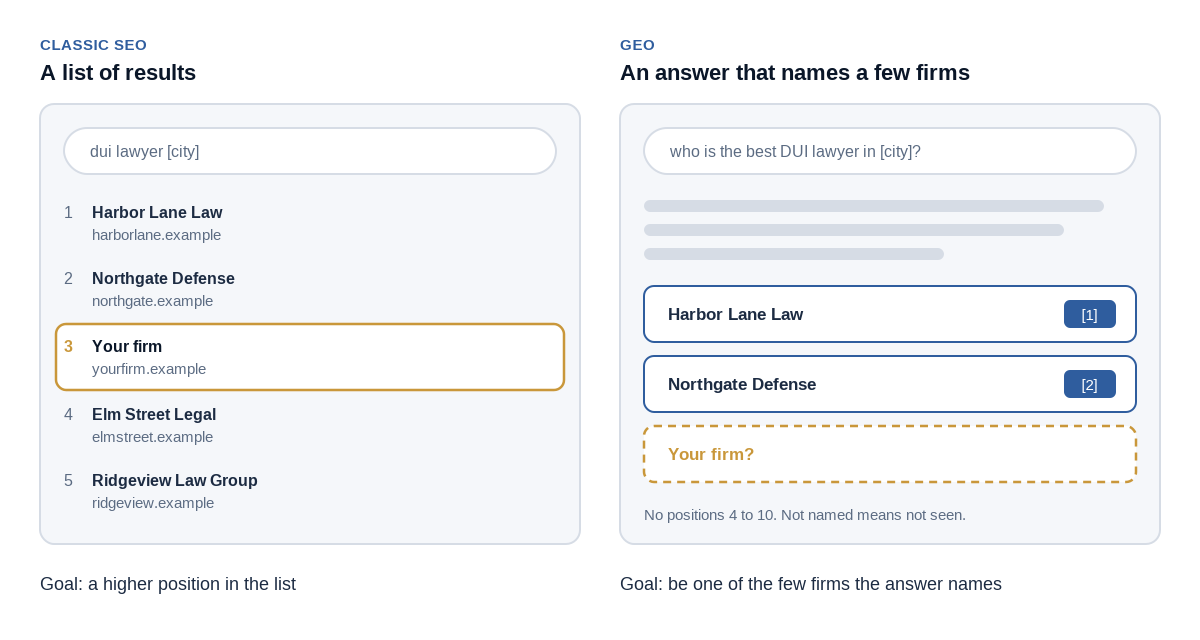
In classic SEO, a win means ranking third for "DUI lawyer Phoenix." In GEO, a win means ChatGPT names your firm when someone types "who's the best DUI lawyer in Phoenix?" at 2 a.m.
Behind that answer, the AI tool doesn't simply look up one query. It breaks the question into related searches, such as reviews, costs and how the local court process works, then pulls ranked pages from its index and writes an answer from what those pages say. Google calls this query fan-out. It's why a firm with one strong page and nothing else rarely gets named.
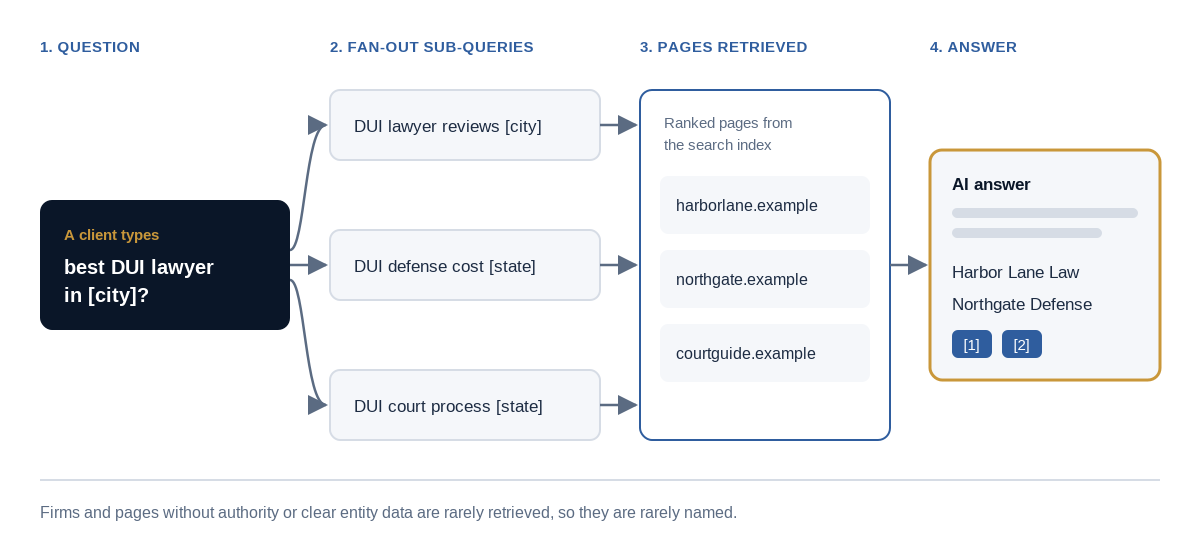
A proper generative engine optimization service usually covers four things:
- Consistent firm, attorney and location data across your site and the wider web.
- Practice-area pages that answer real client questions in plain, quotable language.
- Mentions and links from sources AI systems already trust.
- Regular checks on which prompts return your firm and which return a competitor.
PageOne has a useful breakdown of how AI answers sit alongside featured snippets and the Map Pack in its guide to SERP features and AI Overviews for law firms.
When Did GEO Emerge?
The term came out of academia, not an agency. A paper titled "GEO: Generative Engine Optimization," by Pranjal Aggarwal and five co-authors, was first submitted to arXiv on 16 November 2023. The researchers came from Princeton University, Georgia Tech, the Allen Institute for AI and IIT Delhi. They found that GEO methods could raise a source's visibility in generative engine responses by up to 40%, and the work was later presented at ACM KDD 2024.
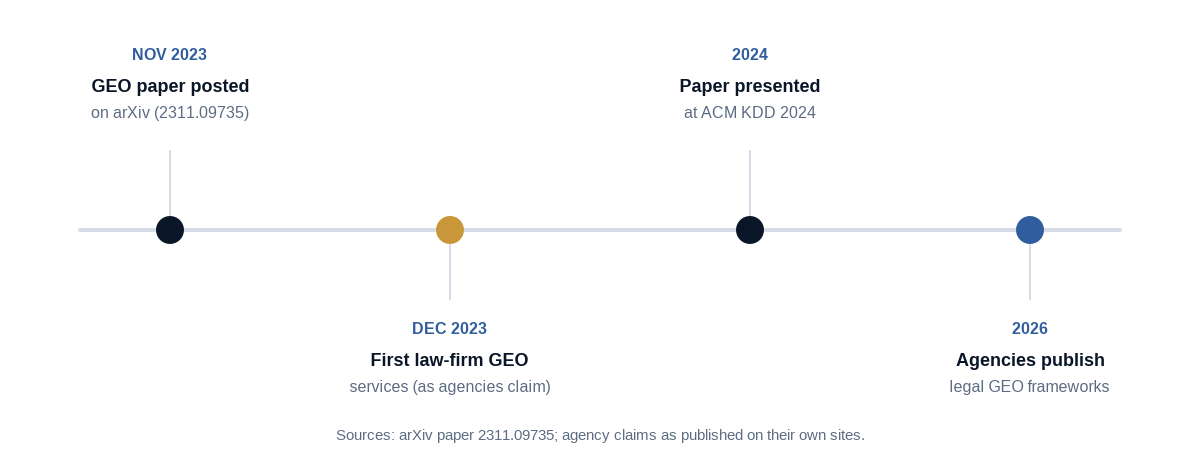
Legal marketing agencies picked it up within weeks, which is why several now claim to have been "first." BigDog ICT says it published a legal GEO framework in November 2023 and launched law-firm GEO services that December. First Page Sage says it was the first agency to offer GEO as a marketing service, and that its first few clients were law firms. Both claims can be partly true. Neither tells you who will do the best work for your firm this year.
How GEO Differs From Law Firm SEO
GEO doesn't replace SEO. Google's own guidance says AI Overviews and AI Mode run on its core ranking and quality systems: they pull real, ranked pages from the index and build an answer from what those pages say. If your site has crawl problems, thin law firm SEO foundations or no authority, it rarely gets cited, however "AI-optimized" the copy is.
What shifts when you think about law firm SEO and AI together is the emphasis. SEO fights for a spot in a list of results. GEO fights to be one of the two or three firms an AI tool actually names. That puts more weight on clean entity data and third-party mentions, and less on keyword coverage.
Google has also been blunt that llms.txt files, content "chunking" and rewriting pages "for AI" don't help in its AI features. If an agency sells those as GEO, keep your wallet closed.
How We Evaluated These GEO Agencies
Most published lists of top GEO SEO agencies score agencies on criteria that happen to favour the author. Review counts and client logos tell you very little about whether an AI tool will ever recommend your firm.
We judged GEO agencies for law firms on six things a managing partner can check without a technical background:
- Legal-sector focus. Does the agency understand bar advertising rules, YMYL content standards and case economics?
- Technical GEO capability. Can it show schema, attorney entity markup and crawl fixes on real client sites?
- Compliance workflow. Is legal content checked for accuracy and jurisdiction before it goes live?
- Citation tracking. Does it report which AI platforms cite you, and for which prompts?
- Case-level attribution. Can it tie AI visibility to consultations and signed cases, not just traffic?
- Pricing transparency. Can you see what you'll pay, and what that buys, before a sales call?
Plenty of leading legal marketing companies for answer engine optimization pass one or two of these tests. Very few GEO optimization companies pass all six. And one rule applies to every agency on this list: no ethical agency can promise your firm will show up in ChatGPT within 30 days, because the AI platforms control their own citation algorithms.
Why Every GEO Ranking Looks Different
If you've read three or four GEO agency lists, you've probably noticed they rarely agree. There are three reasons.
First, the author usually ranks itself. Of the five lists we reviewed for this guide, each one placed its own publisher at or near the top, and only one said so openly.
Second, the "first GEO agency" claims conflict. As the timeline above shows, at least two agencies claim to have been first, and both can point to something from late 2023.
Third, the numbers don't match. One list cites ChatGPT's monthly users and another cites weekly users from a different date, and neither explains the gap. Those figures measure different things, so they can't both be used to size the same opportunity.
None of this makes the lists useless. It means you should read them for the criteria, not the order.
The Top GEO Agencies for Law Firms in 2026
The eight agencies below range from legal-only specialists to multi-industry firms with serious legal practices. Each profile covers who the agency suits and where you should push back.
1. PageOne Lawyers: Best Overall for Legal-Only GEO
PageOne Lawyers works only with law firms, and its GEO offering reflects that. It doesn't sell answer engine optimization for law firms as a pricey add-on. AI SEO and GEO are included in every SEO package, scaled to the plan tier, with plans starting at $200 a month. For a firm already paying for SEO, that answers the "do we need a second budget for AI?" question fairly quickly.
What we like most is how specific its published deliverables are: content structured for LLM retrieval, entity and schema markup for AI extraction, authority signals, citation tracking across ChatGPT, Perplexity and AI Overviews, and Q&A and HowTo content formatted for AI summaries. You can hold that list up against any other proposal, line by line.
Three policies stand out:
- Market exclusivity. PageOne takes only one firm per practice area per market and writes that into every engagement letter.
- Case-level reporting. Monthly reports cover rankings, qualified traffic, calls, forms, booked consultations and signed cases. PageOne connects with intake tools lawyers already use, including Lawmatics, Clio Grow, CallRail and HubSpot.
- Attorney review. AI is used for research and outlining only. Every published word is written by a legal content specialist and reviewed by a licensed attorney.
For anyone buying AI-powered SEO for law firms, the review step matters. Unchecked legal content is a liability, and it's also the kind of content AI tools are least likely to cite.
PageOne builds separate programs for personal injury, DUI, family law, criminal defense, estate planning, immigration and seven other practice areas. A personal injury practice, for example, gets GEO content shaped around its own case types, not a one-size legal template.
The one thing to know going in is the 12-month minimum engagement. There's no auto-renewal and no cancellation fee, but firms hoping for a 90-day trial won't get one.
You can see the full scope on the AI SEO & GEO services for law firms page, or compare tiers on PageOne's SEO and GEO pricing plans.
Source: PageOne Lawyers' own AI SEO & GEO service page, checked 7 October 2026.
2. SEO Discovery: Best for AI Search Inside a Multi-Channel Program
Not every firm wants a legal-only boutique. Some want one vendor running SEO, paid search and AI visibility together, sometimes across more than one country. For those firms, SEO Discovery is the strongest option here.
As a generative engine optimization agency, it treats each AI surface as its own job rather than lumping them together. Alongside a dedicated SEO practice for lawyers, it offers separate services for ChatGPT SEO, Google AI Mode, Perplexity SEO, answer engine optimization and generative engine optimization. That's more useful than it sounds, since each platform picks its sources a little differently.
SEO Discovery has been in business since 2003 and has served clients in more than 20 countries. It has offices in the UK, Canada, Australia and New Zealand. A UK firm shopping for an AI search optimisation company for law firms, or a US firm with cross-border clients, will get more out of that reach than most.
Pricing is refreshingly open for an AI-powered digital marketing firm for law firms. AI SEO plans start from $300 a month, and the agency says there are no setup fees and no long-term contracts. It works well for firms that want GEO optimization services bundled with PPC, local SEO and content under one account manager.
The trade-off is focus. SEO Discovery serves many industries, so ask for legal-specific examples and find out who on the team handles bar advertising rules.
Explore its generative engine optimization services and its SEO for lawyers page.
Source: SEO Discovery's own website, checked 7 October 2026.
3. First Page Sage: Best for Thought-Leadership GEO
First Page Sage shows up on almost every AI search ranking, and its method explains why. Its legal GEO work focuses on placing thought leadership on authoritative third-party websites, much like PR, so the firm reads as the leader in its practice area. It was founded in 2009 in San Francisco and sits firmly at the premium end of the market.
It suits larger firms competing on reputation across several markets. Smaller firms should note that its client base leans toward B2B, and that it costs more, so check the ROI timeline against what your cases are worth. A local practice that needs city-level visibility this quarter may find the pace slow.
Source: published third-party GEO agency rankings, checked 7 October 2026.
4. 9Sail: Best for Signed-Case Attribution
9Sail works only with law firms, and it has published one of the more rigorous frameworks for choosing an agency. Its scorecard covers eight categories: entity optimization, content structure, digital PR, multi-practice architecture, AI platform coverage, signed-case attribution, SEO foundations and ethics. The agency's view is simple: good SEO is good GEO.
It fits best with firms running two or more practice areas, where AI citation outcomes and signed-case ROI get discussed at partner meetings. A solo practitioner may find it more than they need.
Source: 9Sail's published agency guide, checked 7 October 2026.
5. BigDog ICT: Best for Solo Attorneys and Small Firms
BigDog ICT serves only solo attorneys and small law firms, and in 2026 it published its "Law Firm AI Visibility Stack" framework. The agency itself dates back to 2002, so it has more marketing history behind it than most GEO-first shops.
If you're a solo or small firm that wants a defined, legal-specific playbook, it's a sensible shortlist pick. Multi-office firms will likely outgrow it. Either way, ask to see citation tracking for a firm your size, in a market like yours.
Source: BigDog ICT's published research page, checked 7 October 2026.
6. Genevate: Best Pure-Play GEO Plus PR
Among the agencies specializing in generative engine optimization (GEO) from the start, Genevate is notable for its PR background. It was founded by Brett Kleinberg, a New York public relations strategist, and it pairs citation-building with earned media outreach. Its legal clients include Finz & Finz.
Firms that care most about how AI tools describe them, especially on reputation, will find the approach appealing. Its legal track record is still short, though, so if agency tenure weighs heavily in your decision, look further down the list.
Source: published third-party GEO agency rankings, checked 7 October 2026.
7. Rankings.io: Best for Personal Injury Firms
Rankings.io, founded in 2013 in Marion, Illinois, is known for litigation-focused legal SEO and heavy content production. That kind of SEO base is exactly what AI citations tend to grow from, which makes it a natural fit for personal injury and criminal defense firms chasing aggressive growth.
One competing review questioned whether its GEO-specific work (entity consistency, structured data, quote-ready content) has fully matured. So ask for AI citation reports specifically, not just ranking reports.
Source: published third-party GEO agency rankings, checked 7 October 2026.
8. Juris Digital: Best for Technical GEO Foundations
Technical GEO is rarely exciting, and it's often the part firms skip. Juris Digital was founded in 2012 and is based in Denver. It focuses on the problems that quietly stop AI tools from understanding a firm: attorney profiles that don't match across pages, thin practice pages, repeated location pages and weak internal linking.
If your site needs structural repair before any content can work, this is the agency built for it. Some client reviews mention that leads took a while to show up, so go in expecting a longer runway.
Source: published third-party GEO agency rankings, checked 7 October 2026.
Whoever you hire, technical SEO for law firms is usually the first thing to fix.
How Much Do GEO Agencies Charge Law Firms?
AI search ranking services for law firms come in at a wide range of prices, and the published numbers don't always line up.
- Combined retainers. Most law firms pay $3,000 to $10,000 a month for a combined SEO and AEO retainer. Small firms in quiet markets may pay as little as $1,500, and large firms in competitive practice areas often pay $12,000 to $25,000 or more.
- GEO-only work. A one-off GEO audit usually costs $2,000 to $4,500, and ongoing retainers run about $1,500 to $8,500 a month.
- The bottom of the market. One pricing source warns that below roughly $1,000 a month, buyers are often paying for classic SEO with a GEO label attached.
That warning is fair, with one caveat. What matters is whether the GEO work is actually spelled out. A $200 plan that lists entity markup, citation tracking and AI-formatted content is a different product from a $900 plan that just says "AI optimization."
Do You Need Extra Budget for GEO?
Often you don't. One legal content agency points out that the work behind AI visibility is the same work already in most retainers: content, technical fixes and authority building. A firm can point that work at AI citation outcomes without raising its budget.
A simple way to check your current agency is to ask for three things: your attorney schema, an AI citation report, and one page it has restructured for AI answers. If it can't produce them, you're paying for SEO and hoping for GEO.
If you're working with a tight budget, PageOne's guide to solo and small firm SEO covers where the first dollars should go.
Why SEO and GEO Costs Vary for Law Firms
Three things drive most of the difference:
- Practice area. A personal injury market fights over far more valuable cases than a small-town estate planning market.
- Market size. Houston and Los Angeles cost more than Tulsa.
- Scope. Every extra office and practice area needs its own entity signals and content.
Practice area also changes how much GEO is worth to you at all. Urgent matters like DUI defense, fresh personal injury claims and emergency criminal cases involve clients who search and call within hours. For those, Google SEO, your Google Business Profile and paid search do most of the heavy lifting. Research-heavy work, such as estate planning, immigration and business law, tends to benefit more from AI visibility.
Not sure where your firm falls? The four questions below give you a starting point.
How much should your firm prioritise GEO?
Answer four quick questions for a starting point based on how your clients hire.
1. What is your main practice area?
2. How quickly do most clients hire after their first search?
3. How visible is your firm in Google today?
4. How many offices do you have?
Answer all four questions to see your result.
How Much Should a Law Firm Spend on Marketing?
There's no universal percentage, and anyone quoting one without knowing your case values is guessing. A better yardstick is cost per signed case. 9Sail recommends judging GEO budgets that way too, rather than by a flat monthly fee.
Keep in mind that paid search comes on top of agency fees. One legal PPC agency puts typical management fees at $1,500 to $5,000 a month, separate from ad spend of $5,000 to $50,000 a month. Start with what a signed case is worth to your firm and what you can afford to pay to win one, then work backward to a budget.
What This Guide Can't Tell You
We can't tell you which agency will get your firm named in ChatGPT, and neither can anyone else. The AI platforms decide what they cite and change how they do it without notice. That's also why every price above is a range: published figures come from agencies describing their own markets, and your quote will depend on your practice areas, cities and starting point. Treat the ranges as a sense check, not a price list.
How to Choose the Right GEO Agency for Your Law Firm
Whether you're picking an SEO agency or looking at GEO for legal firms, the choice comes down to proof. Most AI-focused marketing agencies for law firms will show you a polished deck. Far fewer will show you a real citation report.
Before any call, open ChatGPT, Perplexity and Google, ask about your practice area and city, and screenshot what comes back. That's your baseline, and any serious geo agency will want to see it.
Questions to Ask a Generative Engine Optimization Expert
Ask every agency the same six questions, in the same order:
- Which AI platforms do you track citations on, and can I see a real report from a law firm client?
- What schema and attorney markup will you put in place in the first 90 days?
- Who checks legal content for accuracy and bar advertising compliance?
- Do you work with any firm in my practice area and market?
- Who owns the content, schema and data if we part ways?
- How will AI-sourced leads be tagged at intake?
If you're comparing SEO proposals for a personal injury law firm, lay the answers side by side and ignore the monthly fee at first. Compare the named deliverables, the reporting and the exclusivity terms. A proposal that can't answer the last question can't prove ROI. PageOne's personal injury lawyer SEO page gives a good picture of what a PI-specific scope should include.
The scorecard below lets you run up to three proposals through the same six questions and red-flag checks.
GEO proposal scorecard
Score up to three agency proposals on the same six questions, then tick any red flags you spotted. Nothing you enter is saved or sent anywhere.
Start by naming an agency or answering a question. Results appear here.
Red Flags
- A promise that you'll be cited by AI, or "in ChatGPT within 30 days."
- No citation tracking at all.
- GEO pitched as a replacement for SEO. AI tools cite content that already has authority.
- The agency keeps ownership of your content or data when you leave.
- Legal content published without attorney review.
- Working with your direct competitor and no written conflict policy.
How to Get Your Law Firm in ChatGPT Search Results
GEO for lawyers starts with a test you can run yourself in about 15 minutes.
- Write ten questions a real client would type, such as "best divorce lawyer in Chicago," "how much does a DUI lawyer cost in Phoenix" and "do I need a lawyer for a minor car accident in Texas."
- Put each one into ChatGPT, Perplexity, Gemini and Google.
- Note which firms get named and which pages get cited.
Most firms find that the names AI tools return aren't the firms ranking first on Google. They tend to be the firms with the clearest entity data and the most mentions elsewhere online.
Answer engine optimization for lawyers is how you close that gap. AI tools lean on the same local authority signals Google does, so local SEO for law firms and your Google Business Profile are very much part of AI marketing for attorneys.
Building a GEO Strategy From Scratch
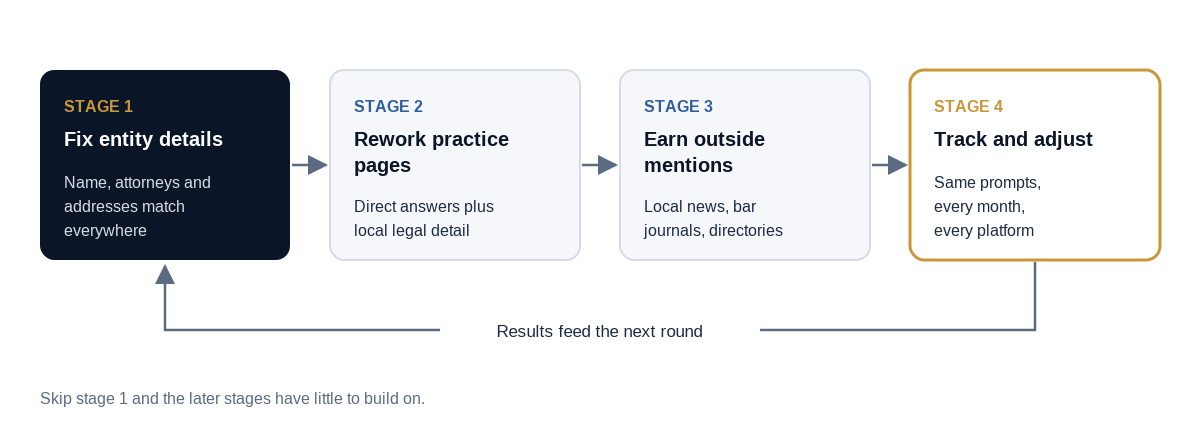
A workable GEO content strategy has four stages.
- Fix your entity details. Your firm name, attorneys, addresses, practice areas and bar admissions should match everywhere: your site, your schema, your Google Business Profile and the directories.
- Rework your practice-area pages. Open each page with a direct answer to the question a client actually asks. Add local detail a generic article can't match, such as your state's filing deadline or how your county's court process works.
- Earn outside mentions. Aim for local news, bar publications and legal directories. AI systems trust what others say about you far more than what you say about yourself.
- Track progress. Re-run your prompt list every month and note what changes.
AI content for law firm websites can speed up research and outlining. Publishing it unreviewed is a mistake, though. Google treats AI-assisted pages exactly like any other content, and legal content is held to a higher standard. Attorney-reviewed legal content is the safer route. For the bigger picture, PageOne's law firm SEO strategy guide shows how GEO fits into a full-year program.
Measuring ROI on Law Firm GEO
AI search optimization for law firms only pays off if it shows up in signed cases. A practical way to track it:
- Tag each AI referral by platform, for example "AI-ChatGPT" or "AI-Perplexity."
- Record the matter type and jurisdiction.
- Follow the lead through consultation.
- Log whether it signed, and why or why not.
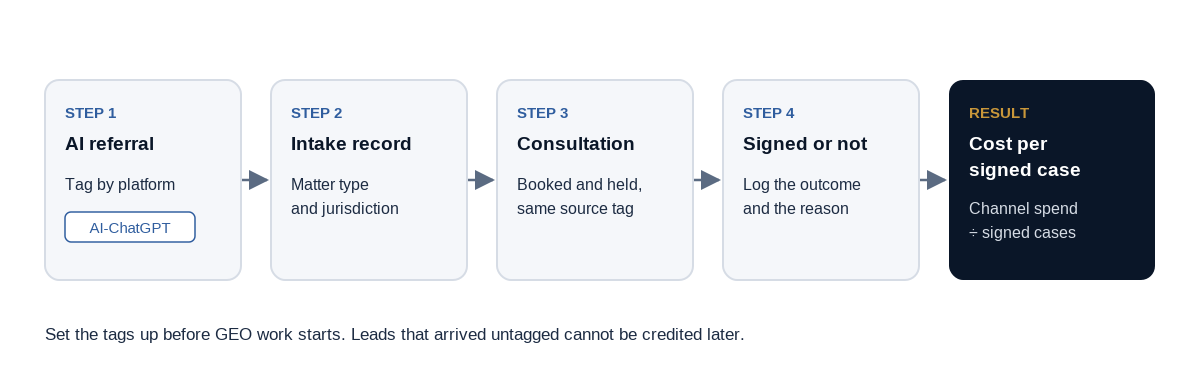
Do this and you'll have a consultation rate and a sign rate for each AI channel, which you can compare directly with organic search and paid ads. Set the tracking up before any GEO work begins, because you can't attribute past leads after the fact. PageOne's analytics and call-tracking setup is built around this kind of source-level reporting.
Once you have a few months of tagged leads, put your own numbers into the calculator below.
Cost per signed case calculator
Enter what you spent on each channel and how many signed cases it produced over the same period, for example the last six months. Use any currency, as long as it is the same for every channel. Nothing is saved or sent anywhere.
Enter spend for at least one channel to see results.
The same rule applies to any AI digital marketing for law firms. If a channel can't show you a cost per signed case, treat it as an experiment.
Frequently Asked Questions
What is GEO for law firms?
GEO, or generative engine optimization, is the practice of getting your firm seen, cited and recommended inside AI-generated answers. That includes ChatGPT, Perplexity, Gemini, Claude and Google's AI Overviews and AI Mode. The work involves consistent entity data, attorney-reviewed practice-area content, mentions on trusted third-party sites and citation tracking. The aim is simple: when someone asks an AI tool which lawyer to hire, your firm should be one of the names it gives.
How is GEO different from law firm SEO?
SEO competes for positions in Google's list of results. GEO competes to be one of the few firms an AI answer names or cites. Both rest on the same foundation, since Google's AI features use its core ranking systems. GEO simply puts more weight on consistent entity data, answer-first content, trusted outside mentions and tracking across several AI platforms.
How much do GEO agencies charge law firms?
Most law firms pay $3,000 to $10,000 a month for a combined SEO and answer engine optimization retainer. Small firms in low-competition markets may pay as little as $1,500, while large firms in competitive areas often pay $12,000 to $25,000 or more. Some agencies include GEO in their standard SEO plans instead; PageOne Lawyers' plans start at $200 a month. Whatever the price, judge it by the deliverables actually listed.
How do I choose the right GEO agency for my law firm?
Start by asking ChatGPT, Perplexity and Google about your practice area and city, and screenshot the answers. Then interview each agency using the same questions. Ask for real law-firm citation reports, their schema plan, their attorney review process, their conflict policy, who owns your data and how AI leads get tagged at intake. Walk away from anyone who guarantees AI citations or can't show you their tracking.
Do I need extra budget for GEO?
Usually not. The work that earns AI visibility is the same work a good SEO retainer already covers: content, technical fixes and authority building. It just needs to be aimed at AI citations. Ask your current agency for your attorney schema, an AI citation report and one page it has reworked for AI answers. If it can't show you those, you may need a different agency rather than a bigger budget.
When did GEO (generative engine optimization) emerge?
The term first appeared in an academic paper, "GEO: Generative Engine Optimization." It was submitted to arXiv on 16 November 2023 by researchers from Princeton, Georgia Tech, the Allen Institute for AI and IIT Delhi, and was presented at ACM KDD 2024. Legal marketing agencies started offering GEO services within weeks of its release.
How to get your law firm in ChatGPT search results?
Make your firm easy for AI tools to recognise and verify. Keep your name, attorneys, locations and practice areas consistent across your site, schema, Google Business Profile and directories. Publish attorney-reviewed pages that answer real client questions directly, and earn mentions in local news and legal publications. Then re-run the same list of client-style prompts each month to see whether ChatGPT starts naming you.
How to measure ROI on law firm marketing spend?
Look at cost per signed case for each channel, not clicks or impressions. Tag every lead's source at intake, with a separate tag for each AI platform, and follow it through to a signed or unsigned result. Then divide what you spent on each channel by the cases it brought in. Firms that set this up before launching new marketing can compare GEO, SEO and paid search fairly.
Picking among the top GEO agencies for law firms comes down to fit. PageOne Lawyers is the pick if you want legal-only GEO built into your SEO retainer and reporting that counts signed cases. SEO Discovery makes more sense if you want AI search running alongside paid, local and international campaigns. The specialists further down this list suit narrower needs. Whichever names end up on your shortlist, run the baseline test before your first call.
Want to see where your firm stands in AI search right now? Get a free law firm SEO audit from PageOne Lawyers.