To measure ROI on law firm marketing spend, you need to add up every marketing cost, trace each signed client back to the channel that produced them, and compare the fee revenue to what you spent. The core formula is (revenue from marketing-sourced clients minus total marketing cost) divided by total marketing cost. Most firms stall at the second step, because they count leads but never connect them to signed cases. This guide shows you how to close that gap.
How to measure ROI on law firm marketing spend, step by step
1. Add up your true marketing costs
Start with direct spend: Google Ads, Local Services Ads, social ads, directory listings, SEO or content fees, and any print, radio, or TV. Then add the indirect costs most firms forget, such as CRM and call-tracking subscriptions, freelance writers, and the staff hours spent managing campaigns. If a paralegal spends five hours a week on intake follow-up, that time belongs in the total.
2. Track every lead to its source
Use a unique tracking phone number for each channel, so a call from your Google Business Profile looks different from a call off a billboard. Set up form submissions and click-to-call as conversion events in Google Analytics 4. Then train your intake team to ask every caller, "How did you hear about us?" and log the answer in one place.
Call tracking and intake notes will sometimes disagree. A client may click an ad, then call a number they found later through a search. Record both the tracked source and the self-reported source, and review the gaps monthly.
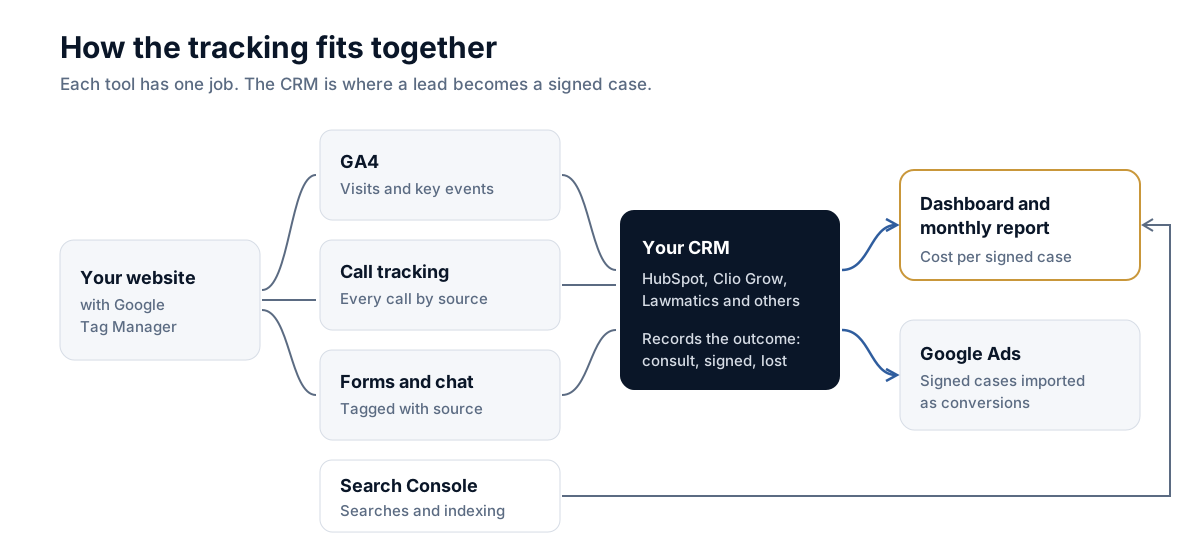
3. Connect leads to signed clients and revenue
A lead is not a client, and a client is not yet revenue. Your CRM should show where each matter stands: inquiry, consultation, signed, and fees collected. This is where law firm marketing analytics becomes useful, because it ties each stage back to its source.
| Metric | Formula | What it tells you |
|---|---|---|
| Cost per lead (CPL) | Total spend ÷ total inquiries | How efficiently a channel generates interest |
| Cost per acquisition (CPA) | Total spend ÷ signed clients | What each new client really costs |
| Client lifetime value (CLV) | Average case value × repeat and referral business | How much a client is worth over time |
| ROI | (Revenue − cost) ÷ cost × 100 | Whether the channel pays for itself |
Bottom line: CPL is a useful early signal, but CPA and ROI decide where your budget should go.
A worked example: what the math looks like
This is an illustrative scenario with made-up numbers, not a client result. A family law firm spends $6,000 in a month on Google Ads and $2,000 on content and SEO, for $8,000 total. The ads produce 60 inquiries, and the content produces 25. Together they lead to 10 signed clients, each paying an average of $4,500 in fees.
Revenue is $45,000, so ROI is ($45,000 minus $8,000) divided by $8,000, or about 462%. CPL is roughly $94 and CPA is $800. The firm can now compare each channel on signed clients instead of raw clicks. That comparison often changes the budget more than any other single step.
Law firm marketing ROI calculator
Use numbers from the same period. Nothing is saved or sent anywhere.
Agency fees plus ad spend for the period
Same period
What you expect to collect per case
Calls, forms and chats in the same period
Enter spend, signed cases and average fee to see your results.
How much should a law firm spend on marketing?
There is no single correct number. The U.S. Small Business Administration has long suggested that businesses with under $5 million in revenue set aside roughly 7 to 8 percent of gross revenue for marketing, and many legal marketers treat that as a starting range. Newer firms trying to grow quickly often spend more, while established firms with strong referral networks may spend less.
Practice area changes the picture too. A personal injury firm competing on high-cost keywords has different economics than an estate planning firm that relies on local trust. Set a budget based on your target cost per signed client, then work backward.
Does content help law firm marketing, and how do you measure it?
Yes, content helps law firm marketing, but it behaves differently from paid ads. Ads stop producing the day you stop paying, while a well-built guide or practice-area page can keep bringing in inquiries for years. The tradeoff is time, since content typically takes several months to gain traction.
To measure content marketing ROI, track organic sessions, form fills and calls from organic traffic, and signed clients whose first touch was a blog or practice page. Judge it over six to twelve months, not thirty days. In practice, what we see at Page One Lawyers is that firms who evaluate content on a monthly cycle often cut it right before it starts working.
Measuring ROI in Los Angeles without overpaying
Los Angeles is one of the most crowded legal markets in the country, so competition pushes up the cost of paid clicks and agency retainers. That is why many firms ask how to find cheap rate law firm marketing in Los Angeles. Cheap is fine if the cost per signed client stays low, and it is a problem if you are buying low-quality leads.
Before hiring anyone, ask what they report on. If the answer stops at impressions and clicks, keep looking. A good partner should show you calls, signed cases, and cost per acquisition.
How to use data to improve law firm marketing campaigns
Once the numbers are flowing, review them monthly and act on three things. Shift budget from channels with high CPA to those with low CPA. Fix intake if many leads never convert, because a missed call is a marketing loss too. Double down on the practice areas and locations producing your highest-value cases. This is the practical core of using data to improve law firm marketing campaigns.
Myth: "More leads always means better marketing."
Reality: Volume only matters if leads are qualified. A channel with 100 weak inquiries and one signed client can cost far more per case than a channel with 15 inquiries and five clients.
Conclusion
Measuring marketing ROI comes down to three habits: count every cost, track every lead to its source, and tie signed clients to revenue. Once you do, budget decisions stop being guesses. Start this week by adding a source field to your intake form and a tracking number to your top channel.
If you want help setting up tracking and reporting that show which dollars bring in clients, contact Page One Lawyers for a marketing review.
FAQs
Q: What is a good ROI for law firm marketing?
A: There is no universal benchmark, but a positive return after your first six to twelve months is a reasonable target. Results vary by practice area, case value, and market. A firm with high-value cases can accept a higher cost per client than one handling lower-fee matters.
Q: How long does it take to see ROI from law firm marketing?
A: Paid ads can produce leads within days, while SEO and content usually need three to six months or more. Contingency fee cases add another delay, since revenue may not arrive until settlement. Track leads and signed clients in the meantime so you can see progress before fees are collected.
Q: How do I track which marketing channel brought in a client?
A: Use unique call-tracking numbers, Google Analytics 4 conversion events, and a "How did you hear about us?" question at intake. Log all three in your CRM. Comparing them helps you catch cases where the tracked source and the client's answer differ.
Q: How much should a law firm spend on marketing?
A: Many firms start with about 7 to 8 percent of gross revenue, based on U.S. Small Business Administration guidance for small businesses. Fast-growing firms may spend more, and referral-heavy firms may spend less. The better test is whether your cost per signed client leaves a healthy margin.
Q: How do I measure ROI for law firm content marketing?
A: Count the calls, forms, and signed clients that started with an organic visit, then compare their fee revenue to what you spent on content. Review it over six to twelve months. Include writer fees, editing, and staff time in your cost figure.
Q: Does content help law firm marketing?
A: Yes, content builds long-term visibility and trust that paid ads cannot. Useful guides answer client questions before they ever call a lawyer. It works best alongside intake tracking, so you can prove which pieces bring in cases.