Law firm performance metrics are the numbers that show how well a firm earns, spends, staffs and wins work. The useful ones fall into four groups: financial, productivity, client and marketing. Most firms track too many of them and act on too few.
A dashboard with 40 widgets doesn’t make a firm data-driven. It makes it busy. The goal is a short list of numbers you review on a fixed schedule, with an owner for each one and a clear action when it moves. Everything below is built around that.
Key performance metrics for law firm management
Start with the numbers that explain where money is made and lost. These are the core of key performance metrics for law firm management:
| Metric | What it tells you | Review |
|---|---|---|
| Utilization rate | Billable hours as a share of available hours | Monthly |
| Realization rate | Billed value vs. standard value of the work | Monthly |
| Collection rate | Cash collected vs. amount billed | Monthly |
| Lock-up days | Days between doing work and getting paid | Monthly |
| Profit per lawyer (or partner) | Profitability once overheads are in | Quarterly |
| Matter profitability | Margin on each matter or practice area | Quarterly |
| Client concentration | Share of revenue from your top 5 clients | Quarterly |
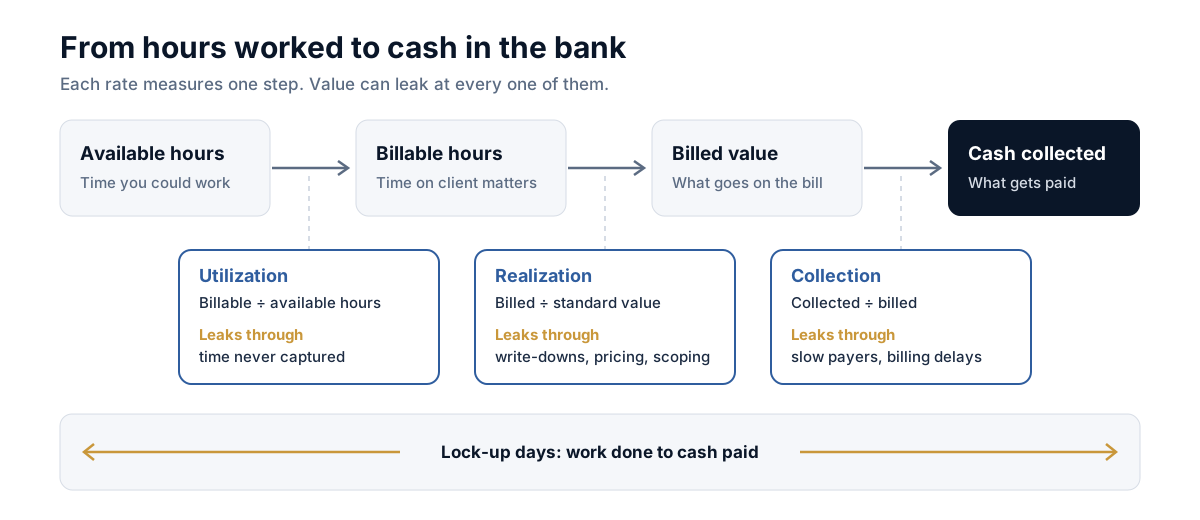
Pro tip: Realization and collection rates are the two to watch first. A firm can hit its billable-hours target and still leak cash through write-downs and slow payers. High utilization with low realization usually means pricing or scoping is off, not effort.
Utilization, realization and collection calculator
Use numbers from the same period. Fill in any pair to see that rate. Nothing is saved or sent anywhere.
Using your firm's own definition
Same period
Billable hours × standard rates
After write-downs
Against those bills
Enter at least one pair of numbers, for example available and billable hours.
Common mistake: Judging a lawyer on utilization alone. A partner who spends hours on business development or mentoring will look “underutilized” on paper while driving the firm’s growth. Pair utilization with origination and matter outcomes before drawing conclusions.
How to track law firm performance metrics (utilization and panel counsel)
If you run a firm, utilization is the number most likely to be measured badly. Three habits fix most of the problems:
- Define “available hours” once. Decide what counts (holidays, training, leave) and write it down. Changing the definition mid-year makes trends meaningless.
- Capture time daily. Time reconstructed at month-end undercounts. Lost minutes become lost revenue.
- Separate billable, non-billable and business development. This is the only way to see where unbilled hours go.
Panel counsel arrangements need a different lens. If you sit on a client’s panel, or you manage one, the question is how outside firms perform for the client. The scorecard usually covers:
- Cost against budget and against the agreed fee estimate
- Cycle time, meaning how long matters take to resolve
- Outcome quality versus the client’s goals
- Responsiveness and communication
- Accuracy of invoices and how often they are disputed
Agree the scorecard before the first matter starts, then review it quarterly. Firms that learn the criteria only after a poor rating rarely recover the relationship.
Law firm marketing metrics that connect to revenue
This is where most firms lose the thread. Law firm marketing metrics only matter if they trace back to signed clients.
Vanity metrics: impressions, page views, social followers.
Useful metrics:
- Qualified leads: inquiries that fit your practice areas and case criteria
- Intake conversion rate: share of qualified leads that become consultations, and consultations that become clients
- Cost per signed case: total marketing spend divided by new clients, by channel
- Organic visibility on practice-area and local terms: rankings, local pack presence, and whether your firm is cited in AI-generated answers
- Lead source quality: which channels bring retained matters, not just calls
- Call and form tracking: so every inquiry has a source attached
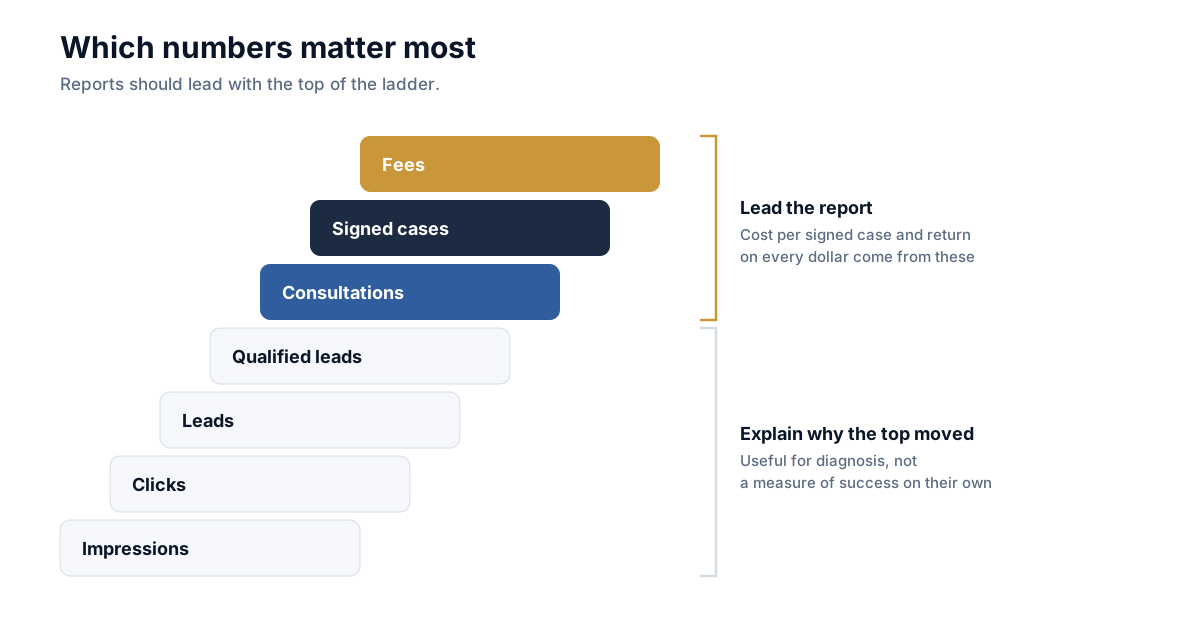
Expert insight: The channel with the cheapest lead is rarely the channel with the cheapest client. A firm can pay little per click and still lose money if those leads never retain. Always measure cost per signed case, not cost per lead.
Traffic that never turns into clients is a separate problem. We covered that in how law firms turn SEO traffic into new clients, and the ROI math is laid out in how to measure ROI on law firm marketing.
How to compare law firm performance against industry benchmarks
Benchmarking is useful, and also easy to get wrong. A few rules keep the comparison honest:
- Compare like with like. Match by practice area, firm size and region. A solo family-law practice and a 50-lawyer corporate firm have different healthy numbers.
- Use named, recent sources. Annual surveys such as the Clio Legal Trends Report, Thomson Reuters Institute’s law firm financial data, and your bar association’s research are better than a round number from a blog. Check the report year, because figures shift.
- Benchmark against yourself first. Your own trend over 12 months tells you more than a peer average.
- Look at the gap, then the cause. A below-average collection rate might come from billing delays, weak engagement letters or a payment-plan problem. The benchmark flags it. It doesn’t diagnose it.
Did you know? Many small firms track no marketing benchmarks at all, so even a basic monthly view of cost per signed case puts you ahead of a lot of local competitors.
Essential metrics for evaluating legal software performance
Software is a cost line like any other, so test it against results. The essential metrics for evaluating legal software performance are:
- Adoption rate: share of staff using it weekly. Low adoption means you are paying for shelfware.
- Time saved per task: measure intake, drafting or billing time before and after rollout.
- Error and rework rate: for example, invoice corrections or missed deadlines.
- Data accuracy: whether reports match what the partners see in practice.
- Integration health: whether time, billing and CRM data flow without manual re-entry.
- Cost per user against measurable gain: a simple payback period works well.
- Support response and uptime: these matter most during month-end billing.
Review a new tool at 30, 90 and 180 days. If the numbers haven’t moved by day 90, find out why before renewing.
How to choose the metrics that actually matter
You don’t need all of the above on day one. Pick by the problem you’re solving:
- Cash flow is tight: realization, collection rate, lock-up days
- Growth has stalled: qualified leads, intake conversion, cost per signed case
- Team feels overloaded: utilization, matter profitability, staffing per matter
- Clients are leaving: responsiveness, client concentration, satisfaction feedback
Choose five to seven numbers. Give each an owner and a monthly review date. Drop any metric nobody acts on.
Ready to see which numbers are costing you clients?
Page One Lawyers helps law firms tie marketing to signed cases, with tracking, reporting and SEO built around the metrics above. Book a free consultation and we’ll show you where your leads are really coming from.
FAQs
1. What are the most important law firm performance metrics?
Realization rate, collection rate, utilization rate and profit per lawyer cover financial health. Intake conversion rate and cost per signed case cover growth. Together they show whether the firm is earning, collecting and winning work.
2. What is a good utilization rate for a law firm?
It depends on role, practice area and firm size, so there isn’t one universal figure. Associates are usually expected to bill more than partners, who spend time on management and business development. Compare against surveys for your own segment and track your trend.
3. How do you track utilization in panel counsel arrangements?
Agree a scorecard with the client up front covering budget accuracy, cycle time, outcomes, responsiveness and invoice quality. Capture time at the matter level and review it each quarter against the agreed fee estimate.
4. What law firm marketing metrics should I track?
Track qualified leads, intake conversion rate, cost per signed case, lead source quality and organic visibility on practice-area and local searches. Skip impressions and followers unless they link to retained clients.
5. How do I compare my firm’s performance against industry benchmarks?
Use recent, named surveys filtered by practice area, firm size and region. Then compare your own numbers month over month so you spot real movement, not noise.
6. How do I know if my legal software is performing well?
Check adoption, time saved per task, error rates, data accuracy and cost per user against the gain. Review at 30, 90 and 180 days.
7. How often should a law firm review its performance metrics?
Financial and productivity metrics monthly, strategic ones like profitability and client concentration quarterly. Marketing numbers are best reviewed monthly, with a deeper channel review each quarter.