SEO helps law firms generate leads by putting them in front of people at the exact moment they're searching for legal help, but only when the strategy mirrors how a real prospective client behaves online. Most firms that "try SEO" and see nothing happen weren't doing it wrong so much as treating it like a switch instead of a pipeline.
This article walks through that pipeline: how a person goes from typing a panicked search into Google to sitting across the table from an attorney, and where most firms lose people along the way.
Can SEO Really Help Law Firms Generate More Leads?
Short answer: yes, and the mechanism is simpler than most agencies make it sound. When your firm ranks for the terms people actually search, such as "car accident lawyer near me," "how to file for divorce in Arizona," or "what happens after a DUI arrest," you're standing in front of someone at the exact moment they're deciding who to call.
Paid ads can put you there too, but only while the budget's running. Organic rankings keep working in the background, month after month, without a per-click bill.
More than 90,000 people search for "personal injury lawyer" every month in the U.S., and that's before counting local "near me" variations. Most of that demand goes straight to whichever firm shows up first.
The catch is that legal search is brutally competitive. You're not just up against the firm down the street; you're up against every national chain with a marketing budget the size of a small country's GDP. That's exactly why a scattershot approach, a few blog posts here, a keyword stuffed there, rarely moves the needle. It takes a structured strategy.
How SEO Helps Law Firms Get More Clients
The honest version of "SEO helps law firms get more clients" isn't about tricking an algorithm. It's about removing every friction point between a person's question and your firm's answer. A well-built law firm SEO strategy does three things simultaneously: it gets your firm found, it builds enough trust that the click actually happens, and it makes sure the page someone lands on doesn't waste that click.
Nobody searches for "personal injury lawyer" for fun. Every one of those searches represents a real situation, a wrecked car, a lost job, a custody dispute, and a real decision that needs to get made, often within days. SEO's job is to intercept that decision-making moment with content that actually answers the question the person is asking, not content written to please a search engine.
People have gotten wise to ads. A paid listing at the top of a results page reads as "someone paid to be here." An organic result reads as "Google thinks this firm is legitimate enough to rank." For a decision as high-stakes as hiring a lawyer, that difference in perceived trust matters more than most firms realize. It's often the deciding factor in which link actually gets clicked.
See how this connects to your firm's practice-area strategy.
The Journey: From Search to Consultation
Ranking well is only step one. The full path below shows how an urgent search becomes a signed client, and where firms typically lose people.
- Step 1, the problem triggers a search. Someone gets arrested, gets served papers, or gets hurt. They type a specific, urgent question into Google, such as "what to do after a hit and run," not "personal injury services." Firms that optimize only for broad keywords miss the person who is further along and more ready to hire.
- Step 2, trust signals decide the click. A searcher scans titles, star ratings, and snippets in about two seconds. Visible reviews, a clear practice-area match, and a title that speaks plainly win over vague, keyword-stuffed copy.
- Step 3, the landing page converts or loses the lead. It must answer the visitor's question quickly, show real evidence of experience, load fast, and make contacting the firm nearly effortless.
- Step 4, follow-up turns a lead into a signed client. A form submission is a moment that either gets capitalized on or wasted. Firms that respond within minutes convert dramatically more leads than firms that respond the next day.
How to Generate Leads for Law Firms Online
A practical lead-generation strategy focuses effort on the pages, local visibility, site health, and trust signals that prospective clients actually encounter.
Want us to apply this to your firm?
Get a free SEO audit, we'll pinpoint exactly where can seo help law firms generate more leads? is costing you cases.
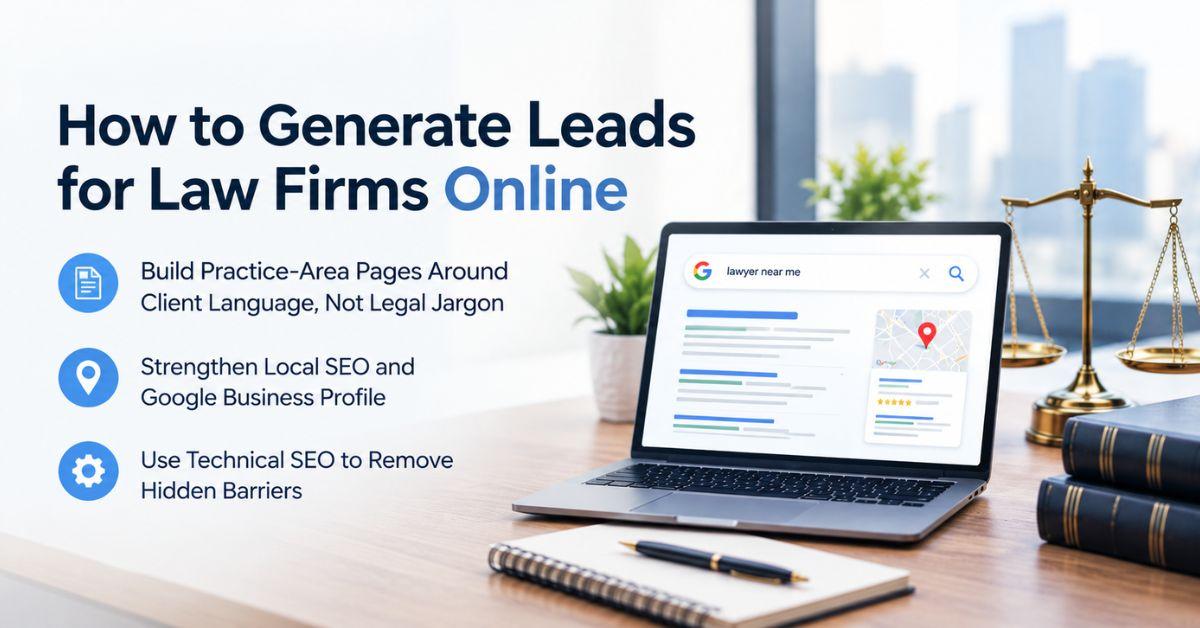
Build Practice-Area Pages Around Client Language, Not Legal Jargon
A page about personal injury law shouldn't open with "tort liability and negligence elements." It should open with what a scared, injured person actually wants to know: what to do next, what it might cost, and what a case could be worth. Write for the reader who's never spoken to a lawyer before, because that's usually who's reading it.
Strengthen Local SEO and Google Business Profile
The majority of legal searches carry local intent, and Google's local map results often sit above the regular organic results entirely. An incomplete or outdated Google Business Profile is one of the most common reasons a firm is invisible in searches it should easily win. A focused local SEO for law firms service connects those local signals with the pages people use to choose counsel.
Use Technical SEO to Remove Hidden Barriers
None of the content work above matters if a search engine can't properly crawl, load, and understand your site. This is where technical SEO for law firms comes in, fixing slow page speed, broken links, duplicate pages, and missing structured data that quietly caps how well even great content can rank. It's unglamorous work, but it's often the fastest lever a firm can pull, because fixing a technical problem can unlock rankings that content alone never will.
Earn Trust Signals: Reviews, Bylines, and Real Case Outcomes
Google and, more importantly, the person reading your site, wants to know who's actually behind the content. Visible attorney bylines, real client reviews, and honestly described case outcomes all build the kind of credibility that both search engines and skeptical visitors respond to.
SEO Marketing for Law Firms vs. Paid Ads
Paid ads and SEO aren't rivals so much as two tools with very different time horizons. PPC buys immediate visibility, but that visibility disappears the moment the budget does. SEO marketing for law firms takes longer to build, usually a few months before meaningful movement, but it keeps generating consultations without a recurring per-click cost.
PageOne Lawyers works exclusively with legal clients and frames SEO as a compounding asset: the content and technical work done in month one keeps paying off in month twelve, which isn't something a paid campaign can claim once it's switched off. Review our law firm SEO services and transparent pricing to compare the scope with your current plan.
The strongest approach usually isn't "SEO or PPC." It's using paid ads for immediate visibility while SEO builds toward becoming the dominant, sustainable channel.
Common Mistakes Law Firms Make With SEO
A few patterns show up again and again in firms that feel like SEO isn't working:
- Chasing broad, generic keywords instead of the specific, high-intent phrases real clients actually type.
- Publishing thin practice-area pages that exist to target a keyword but don't actually help the reader.
- Ignoring technical SEO entirely, so even strong content never gets fully indexed or ranked.
- Treating leads as the finish line instead of building a fast, responsive intake process to convert them.
- Expecting overnight results, then abandoning a strategy right before it starts compounding.
Turn Search Visibility Into Booked Consultations
SEO doesn't hand a law firm leads. It builds the visibility, trust, and pathway that turn a stressed-out searcher into a booked consultation. The firms that get real results treat it as a full journey, from the first search to the follow-up call, not just a ranking checkbox.
Ready to see where your firm actually stands? Book your free audit today and find out exactly where potential clients are searching for you, and where they're slipping away before they ever pick up the phone.