To get your law firm in ChatGPT search results, create helpful legal content, optimize your website for relevant keywords, and answer common client questions. Maintain an updated Google Business Profile, earn quality backlinks, implement relevant schema markup, and build trust through expert content and consistent business information across online platforms.
This article walks through exactly what ChatGPT checks before it names a firm, and the specific fixes that move a firm from invisible to cited.
Can a Law Firm Actually Get Found in ChatGPT Search Results?
Short answer: yes, but not by chasing keywords the way you would for Google. ChatGPT pulls its answers from a live Bing search layer plus a handful of legal directories and review sites it treats as trustworthy. When someone asks "who's a good DUI lawyer in Austin," the model isn't scanning your website in real time, it's cross-referencing whatever it already knows about your firm from those sources and deciding whether you're confirmable enough to name.
Did you know? 41.9% of U.S. consumers say they'd use ChatGPT to research an attorney, up from 28.1% just a year earlier, and over half would use some AI answer engine during their search. Adults 45 to 60, often the exact demographic behind personal injury, estate planning, and family law cases, show the highest AI usage of any age group.
That shift is happening fast, and most firms still have a Bing listing they've never touched and directory profiles with three different versions of their own address.
How Law Firms Get Found in AI Search vs. Traditional SEO
The honest version of law firm SEO for AI search isn't a replacement for your existing SEO, it's a layer on top of it that solves a different problem. Traditional SEO gets a page to rank. AI search optimization for law firms gets a firm recognized as a real, verifiable entity the model is willing to stake its answer on.
From Anonymous Firm to Confirmable Entity
ChatGPT cross-references multiple sources before naming a firm: your website, your Bing and Google listings, your directory profiles on Avvo, Justia, and FindLaw, your state bar record. If those sources disagree on even small details, a suite number here, an abbreviated city name there, the model has reason to hesitate. Consistency isn't a nice-to-have, it's what turns a vague mention into a confident citation.
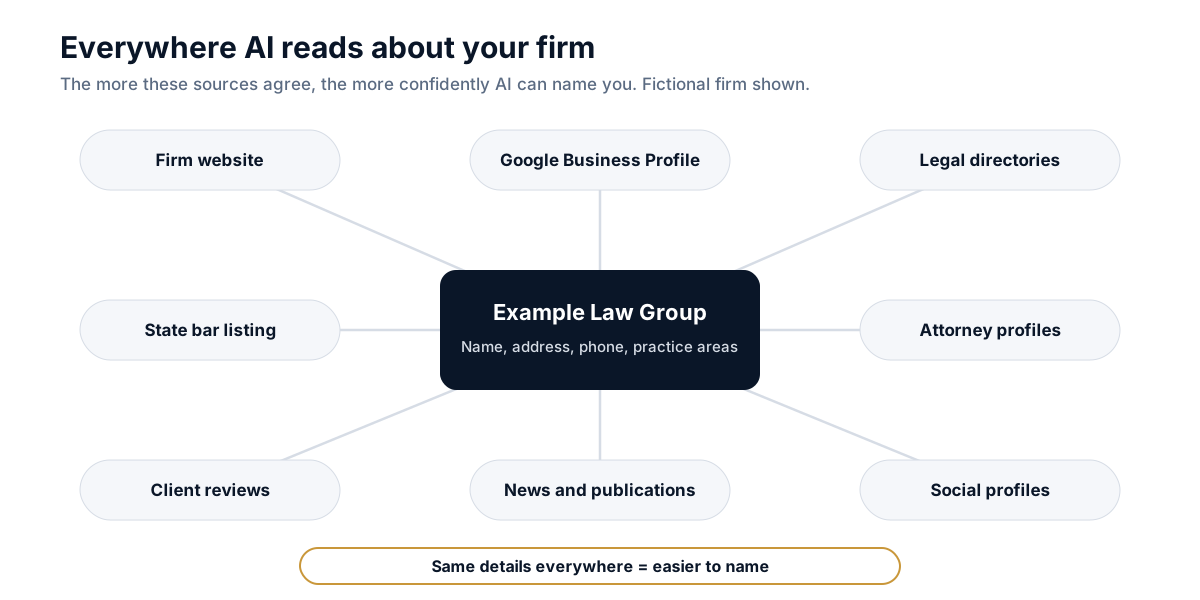
Why Specificity Beats Broad Positioning
"Full-service law firm" gives an AI model nothing to anchor to. "Chicago workers' compensation attorney handling denied claims and appeals" gives it an exact slot to recommend you into. Pick one clear identity line for your firm and repeat it, word for word, everywhere your name appears online.
The Path: From AI Search to Verified Citation
This is the part most law firm content on this topic skips. Getting technically eligible to be cited is only step one. Here's the full path, and where firms typically fall out of it.
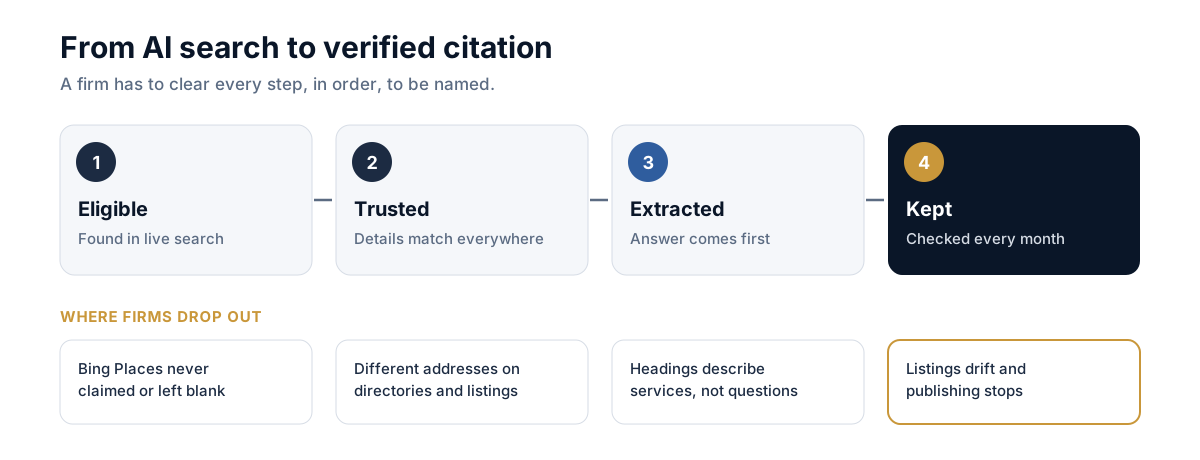
Step 1: The Live Bing Layer Decides Who's Eligible
ChatGPT's search feature fires a real-time Bing query behind the scenes and builds its answer from what Bing surfaces. A firm that's never claimed Bing Places for Business, or left most of its fields blank, is often invisible to this layer entirely, regardless of how well that firm ranks on Google.
Step 2: Entity Consistency Decides Who's Trusted
Once a firm is eligible, the model checks whether it can corroborate what it's seeing. Matching name, address, and phone number across your website, Google Business Profile, Avvo, Justia, FindLaw, Martindale-Hubbell, and your state bar listing is what lets the model treat scattered mentions as one trustworthy entity instead of several weak, unconfirmed ones.
Step 3: Content Structure Decides What Gets Extracted
AI systems pull from pages that answer a question directly near the top, not pages that bury the answer under three paragraphs of throat-clearing. A heading like "What happens after a DUI arrest in Texas?" followed immediately by a plain, concrete answer gets extracted and cited far more often than a heading like "Our DUI Defense Services."
Step 4: Ongoing Monitoring Keeps the Citation
A citation earned today isn't permanent. AI engines re-crawl and re-evaluate sources on their own schedule, so a firm that lets its directory listings drift out of sync or stops publishing can quietly lose the visibility it built. Firms that check their standing monthly catch this before a competitor fills the gap.
AI visibility check
Nothing you enter is saved or sent anywhere.
Enter a practice area and a city to get your four questions.
How to Get Your Law Firm Cited by ChatGPT
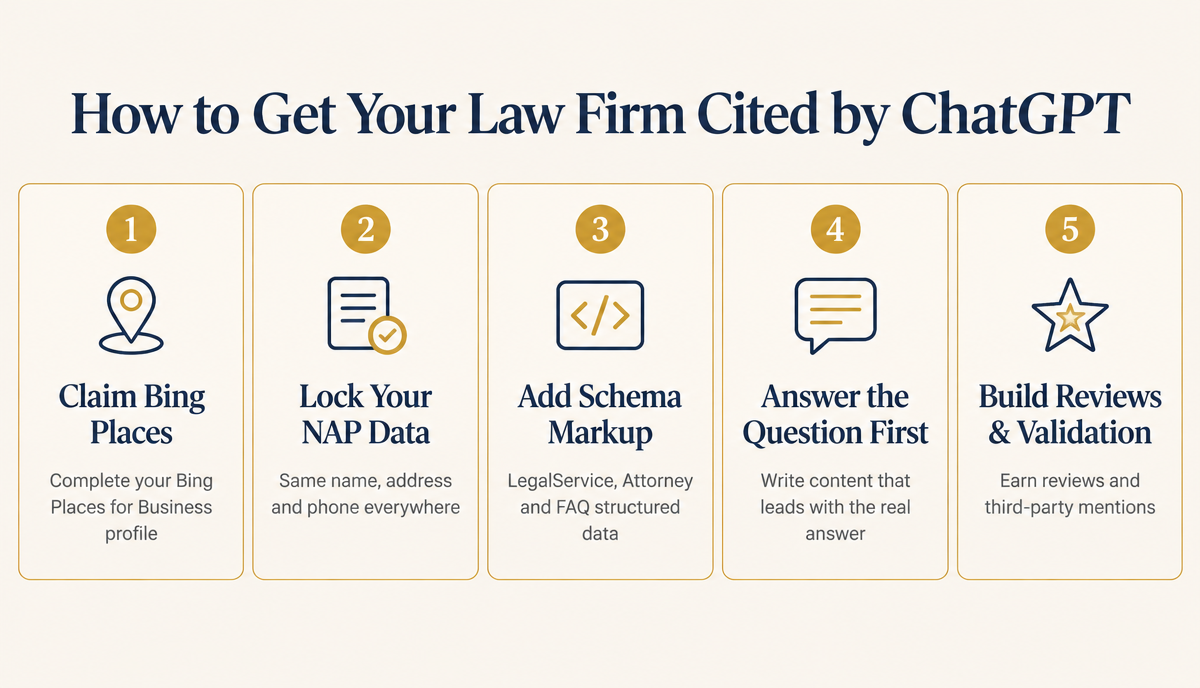
Here's a practical breakdown of where to put the effort first.
Claim and Fully Complete Bing Places for Business
This is the single most skipped step, because years of "just focus on Google" advice left Bing untouched. Claim your listing and fill in every field: hours, practice areas, service area, photos. If your firm barely shows up in Bing, it barely shows up in ChatGPT.
Lock Your NAP Data Across Every Platform
Your firm name, address, and phone number need to be character-for-character identical across your website, Google Business Profile, and every directory listing. This is foundational lawyer seo for ai search engines work, and it's usually a half-day cleanup, not a redesign.
Add Schema Markup So the Machine Can Parse You
LegalService and Attorney schema give AI systems a clean, structured summary of what your firm does and who practices there, instead of making the model guess from unstructured page text.
Write Content That Answers the Real Question First
Structure practice-area pages and blog posts so the first two or three sentences under each heading answer the question completely, then expand with real specifics below it: actual fee ranges, actual timelines for your state, actual process steps, not "contact us to discuss your options."
Build Reviews and Third-Party Validation
A steady stream of recent, detailed reviews does double duty: it helps a human decide to call you, and it gives AI systems evidence your firm is active and reputable right now, not three years ago.
AI Search Optimization for Law Firms vs. Standard SEO
AI search visibility and standard SEO aren't competing strategies, they share the same foundation and diverge from there. A firm with thin content, inconsistent directory listings, and no schema isn't going to leapfrog into ChatGPT citations no matter how well one blog post is worded.
Firms like PageOne Lawyers, which builds seo law program work exclusively for legal clients, treat AI visibility as an extension of the same technical and content foundation that drives organic rankings, not a separate project bolted on afterward. The firms seeing early AI citations are almost always the ones who already had strong lawyer seo for ai search engines fundamentals in place before they started optimizing for it specifically.
Common Mistakes Law Firms Make With AI Search
A few patterns show up again and again in firms that aren't showing up in ChatGPT results:
- Never claiming or completing a Bing Places for Business listing.
- Letting firm name, address, or phone number drift out of sync across directories.
- Writing practice-area headings as service descriptions instead of the actual questions clients ask.
- Treating AI visibility as a one-time setup instead of something checked and maintained monthly.
- Assuming good Google rankings automatically translate into ChatGPT citations.
ChatGPT doesn't hand a law firm visibility. It hands visibility to firms it can verify, cross-reference, and extract a clear answer from. The firms seeing real results treat it as ongoing entity and content work, not a checkbox next to their regular SEO.
Ready to find out where your firm stands in AI search?
Get a quick AI visibility audit from PageOne Lawyers and find out exactly what ChatGPT, Perplexity, and Google AI Overviews currently know, and don't know, about your firm. Book your free audit today and start showing up where your next client is actually searching.
Also Read This Blog: From Search to Consultation: How SEO Helps Law Firms Win Clients
Frequently Asked Questions
Q1. Can a law firm actually "rank" in ChatGPT?
Not in the Google sense. ChatGPT doesn't maintain rankings, it decides per query which firms to cite based on clarity, consistency, and verifiable authority across the web.
Q2. How can a law firm appear in ChatGPT results if it's a small, local practice?
Local firms often have an advantage. Tight NAP consistency, a handful of strong directory profiles, and specific practice-area content can outweigh a large firm's generic, inconsistent footprint.
Q3. How long does it take to see results?
Directory and schema fixes are often reflected within a few weeks. Content-based citations build over months as AI systems re-crawl and re-evaluate sources.
Q4. Does ranking well on Google guarantee a ChatGPT citation?
No. ChatGPT's search feature runs on a separate Bing data layer and its own entity-verification checks, so a firm can rank well on Google and still be invisible to it.
Q5. How often should a firm check its AI search visibility?
Monthly. Ask ChatGPT, Perplexity, and Gemini the exact questions a prospective client would type, "best [practice area] lawyer near [city]," and track whether your firm appears.